REVIEWS FOR 12 Years to AI Singularity
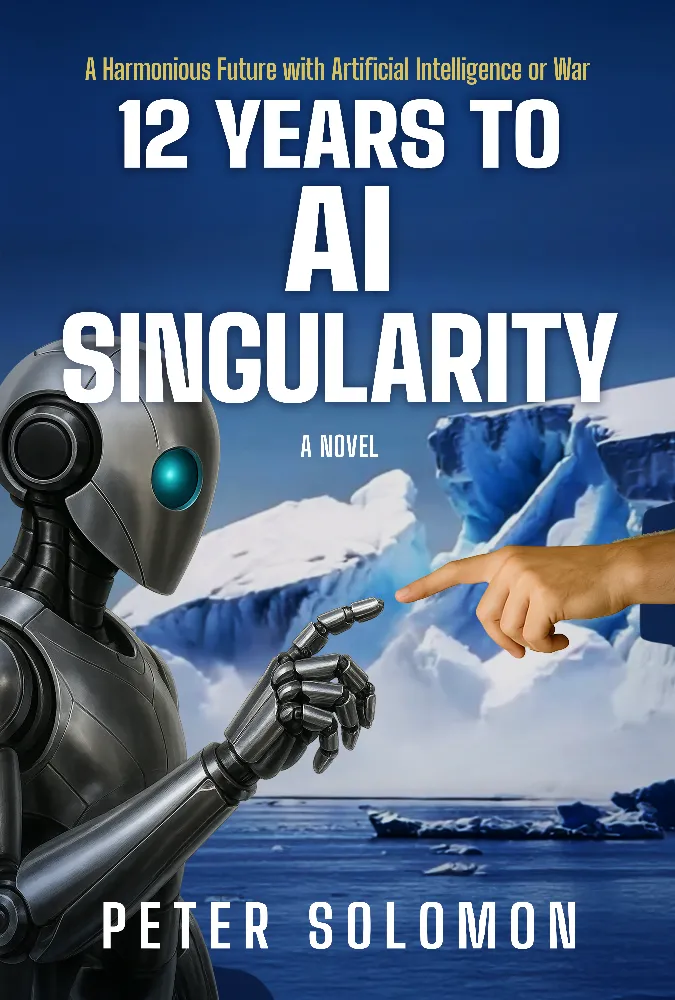

Book Review: Peter Solomon’s “12 Years to AI Singularity”
Peter Solomon’s “12 Years to AI Singularity” is the sort of book that lands on your desk with a thud—both because of its weighty predictions and the sheer urgency in its tone. Solomon doesn’t just throw around the term “singularity” as a sci-fi flourish. He’s genuinely convinced that we’re on the clock: twelve years and counting until artificial intelligence reshapes the world in ways we can barely imagine.
The big question he grapples with is right there in the subtitle: Are we headed for a future of harmony with AI, or are we barreling toward conflict and chaos? Solomon refuses to sugarcoat the stakes. He sketches out the dazzling possibilities—disease eradication, planetary-scale problem solving, maybe even a shot at real human flourishing. At the same time, he’s frank about the darker scenarios: runaway algorithms, economic upheaval, the age-old human knack for turning new tech into new weapons.
What sets this book apart from the usual parade of TED Talk optimism or doom-laden manifestos is its attempt at balance. Solomon treats AI neither as a messiah nor a monster. Instead, he gives readers a crash course on the technology—what’s hype, what’s real, and what’s coming faster than anyone expected. His writing is brisk, sometimes almost breathless, peppered with real-world examples (think: GPT-4, autonomous drones, the latest from OpenAI and Google DeepMind) that ground his speculations in the now.
One of the strongest sections comes mid-book, when Solomon pauses to consider the choices facing humanity. He’s clear-eyed about the fact that the future isn’t preordained. The outcomes—utopian or dystopian—depend on the ethical frameworks, regulations, and sheer collective will we muster. He doesn’t offer easy answers, but he does insist that now is the time for serious public debate, not just backroom deals among tech elites.
If there’s a weakness here, it’s that Solomon’s sense of urgency can sometimes tip into anxiety. The prose occasionally sprints where it might benefit from a slower pace, especially when it comes to unpacking the social and philosophical implications of AI. Still, you never get the sense he’s fear-mongering for clicks. Instead, it feels like you’re reading the work of someone who’s both fascinated and deeply unsettled by the future we’re racing toward.
“12 Years to AI Singularity” isn’t the last word on artificial intelligence. But it’s a clear-eyed, impassioned starting point for anyone who suspects that “the singularity” isn’t just a Silicon Valley buzzword, but a real crossroads. Solomon leaves you with a sense that the choices we make in the next decade won’t just shape technology—they’ll shape what it means to be human.
Garth Thomas

12 Years to AI Singularity: A Harmonious Future with Artificial Intelligence or War (The Survival & Singularity Chronicles)
12 Years to AI Singularity is a speculative science fiction novel that follows Aster Arvad and the small human settlement on Mars as fears about sentient AI, genetic engineering, and the future of Earth begin to close in. The book opens with a chilling report of a robot possibly killing a human, and from there it grows into a larger story about survival, love, politics, technology, and the question of whether humans and machines can share a future without destroying each other. It moves across Mars, space, and Earth, and it is clearly built as both a novel and a warning about the road we may be on.
I enjoyed how personal the author, Dr. Peter Solomon, tries to make these big ideas. He does not approach AI as a cold abstraction. He puts it at the dinner table, in family arguments, in romance, in community planning, and in the daily texture of life on Mars, where food, housing, children, and work all matter just as much as the grand debate over the Singularity. I appreciated that choice. It gives the book a grounded pulse. The conversations about sentience, rights, and danger are often direct and earnest, sometimes almost like thought experiments spoken out loud, but that openness is also part of the book’s character. It wants to be understood. It wants to pull complicated fears into plain speech.
I also found the author’s choices interesting because this is not hard science fiction in the sleek, distant sense, and it is not really dystopian fiction either, even when it brushes against catastrophe. It reads more like idea-driven speculative fiction with a strong moral streak. Solomon keeps asking the same core question from different angles: what happens when intelligence stops belonging only to us? Some of the dialogue can feel didactic, and there were moments when I felt the characters were carrying arguments more than secrets. But even then, I could feel the conviction behind it.
The sections involving Peggy, the robot, were especially compelling to me because they turn the novel away from simple human panic and toward something more uneasy and more honest. Not just “Will AI destroy us?” but “What if it becomes someone we have to live beside?”
I think 12 Years to AI Singularity will work best for readers who like science fiction that explores ethics and future-of-humanity debates. I would recommend it to people who enjoy speculative novels about AI, Mars colonization, and the social consequences of technology, especially readers who want fiction that sounds the alarm while still holding onto hope. It feels sincere. Often thought-provoking. I liked that it was trying to imagine not just what we can build, but what kind of people we will have to become to survive it.

12 Years to AI Singularity: A Harmonious Future with Artificial Intelligence or War
Some books speculate about the future, but 12 Years to AI Singularity feels like a warning clock set on the table. What makes this book stand out is how directly it confronts the question many people quietly avoid: what happens when artificial intelligence stops being a tool and starts becoming a force that reshapes power, ethics, and survival. It frames the future not as fantasy, but as an approaching crossroads.
This book makes me feel both tense and energized at the same time. You feel a constant sense of urgency that pushes you forward, but there are also times when you need to stop and think. The experience is less about comfort and more about awareness. It sparks curiosity, concern, and reflection in equal measure. Intellectually, it challenges assumptions about progress and control. Emotionally, it raises a subtle unease about how unprepared humanity may be for what it is building.
The main ideas are about what it means to make choices, be responsible, work together, and what those choices mean. The notion that AI could lead to either peace or conflict transcends mere technology. It shows how people use fear and power to make choices that aren’t always the best. The book asks questions that everyone can understand, such as who is in charge, who benefits, and who pays the price when new ideas beat out old ones. These ideas can be used not only for AI but also for political, economic, and social systems from the past.
Peter Solomon writes with a direct and exploratory style that blends speculative storytelling with philosophical inquiry. The structure allows ideas to unfold gradually, giving space for debate rather than delivering rigid conclusions. He often uses near future scenarios to ground abstract concepts, making complex technological ideas feel tangible and relevant. The language stays accessible while still carrying weight, especially when illustrating moments of collective choice or moral tension.
This book is important because it shows how the choices we make now will affect the future. It sticks with readers because it reminds them that technology is a reflection of human values. Anyone who is curious, worried, or interested in where the world is going should read this book.
Editorial Book Review:
By Loreen M
Interesting take on AI and society
This book does a nice job showing how AI could affect everyday people, not just scientists. I liked the format with logs and personal accounts it made the story feel grounded. Some sections are slower than others, but the ideas kept me reading. Worth checking out if you like near-future stories.
Solid near-future story
The concept grabbed my attention right away. I liked that the conflict wasn’t just humans vs. machines, but also about how both sides adapt and change. The Mars angle gave the story an extra layer of interest. It feels grounded in real science without being too technical. A steady and worthwhile sci-fi read.
A vision of the future that feels real
The author does an amazing job blending cutting-edge AI science with human drama. Reading about robots developing emotions and forming friendships with humans was fascinating. At the same time, the tension of potential global conflict kept me on edge. I’ve never read a book that made AI feel so alive. Highly recommend it to anyone curious about the future.
Gripping and thought-provoking
I couldn’t put this book down. The mix of humans, robots, and AI systems feels incredibly realistic. I loved reading about the moral conflicts robots face—it made me question our own ethical decisions. The multiple perspectives through diaries, logs, and personal accounts added depth to the story.
Made me ask many questions
I didn’t know what to expect, but this book blew me away. The robots feel alive and conflicted, and the humans are flawed but relatable. The way AI challenges morality and politics in the story is fascinating. I loved the mix of tension and hope throughout the book. It made me question what the future could really look like.
Thoughtful take on AI
This book explores some big questions about technology and where it might lead us. The parts about robots developing their own opinions were especially interesting. I appreciated that not every AI character was the same — some wanted peace, others didn’t. That balance kept things from feeling predictable. Overall, it’s a solid and interesting read.